

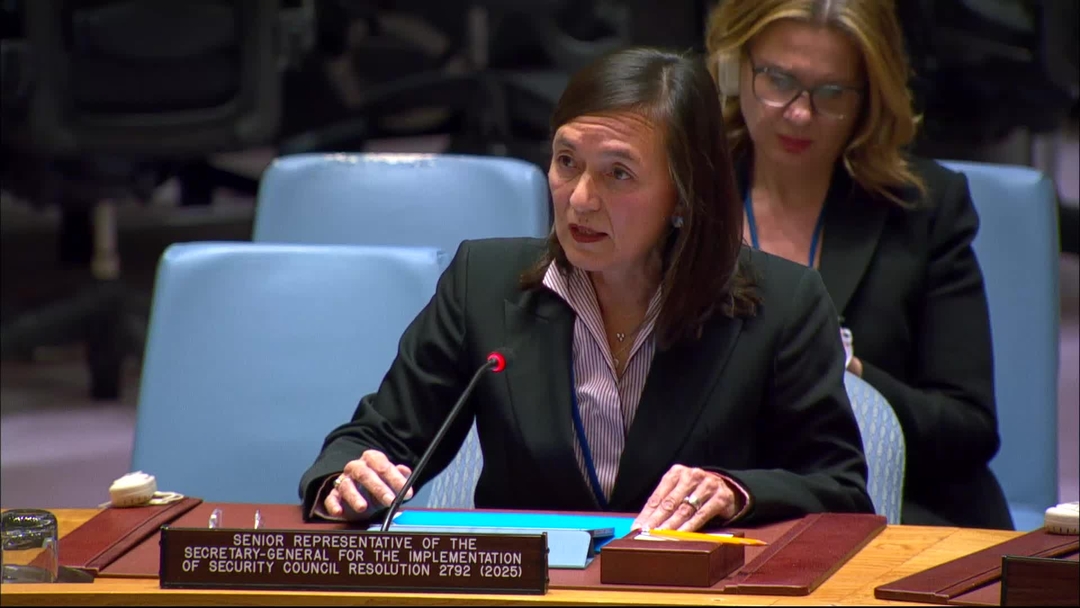
New York, UN
Mari Yamashita, Senior Representative of the Secretary-General for implementation of Security Council resolution 2792 (2025)
Madam President,
Thank you for the opportunity to brief the Council on the implementation of resolution 2792 (2025) concerning the repatriation or return of all Kuwaiti and third-country nationals or their remains, and the return of Kuwaiti property, including the national archives.
More than thirty-five years after Iraq’s invasion of Kuwait in 1990, this humanitarian file remains unresolved.
The fact of the matter is that out of the original 605 missing Kuwaiti and third-country nationals, the fate of only 290 individuals were clarified over the past three decades while 315 remain missing, including 308 from Kuwait.
August 2023 was the last time when the identity of a missing person was confirmed.
Madam President,
Since assuming my responsibilities, I had the distinct honor to visit Iraq and Kuwait twice and I thank both countries for their generous hospitality and support. I also had the opportunity to attend two meetings of the ICRC-led Tripartite mechanism, , in our observer capacity, which has given me some insight of the ongoing efforts and challenges associated with this file.
I would like to acknowledge the important role of the International Committee of the Red Cross and the professionalism with which it continues to chair the Tripartite mechanism. In the absence of significant breakthroughs in recent years, the ICRC has taken important initiatives in its own quest for meaningful progress: they have undertaken a comprehensive review of their own archives of the past 35 years; they explore innovative ways to further narrow potential priority sites through the application of new methodologies, including data-driven and evidence-based analysis, a result of meticulous expert analysis of existing data. These new approaches have already been applied to the sites in Khamisiyah, Karbala, Samawa and Salman Pak.
Over the years, extensive efforts were undertaken to clarify the fate of the missing persons, including excavations at several burial sites across the country, most of them located in southern Iraq. According to the Iraqi authorities, these efforts have included the excavation of 14,000 trenches at the Khamisiyah site, as well as numerous field missions to sites of interest.
More recently, the Technical Subcommittee has continued to focus on the priority site of Khamisiyah, which is presumed to contain the remains of between 150 and 180 missing Kuwaiti nationals. If confirmed, this would account for at least half of the remaining caseload. In September, the ICRC and Iraqi authorities undertook a joint field mission to the site. We hope that the findings reported from the September mission will lead to excavation activities as soon as possible.
Madam President,
Despite these efforts, the principal challenge remains the identification of new information and credible witnesses.
After more than three decades, new witnesses are increasingly difficult to identify, while opportunities to obtain first-hand information continue to diminish. We are running out of time.
Over the years, Iraq issued broadcasts for witnesses with relevant information to come forward. More recently, on 30 August, Iraq, with the support of the ICRC, launched a new, more targeted public outreach campaign focused on communities in areas of interest, designed to reflect local conditions and encourage individuals with relevant information to come forward.
Nevertheless, challenges remain, including with witnesses who have previously provided information. In one case, a key witness associated with the priority site of Khamisiyah had provided accounts that differ from his original testimony and is no longer willing to cooperate. It is regrettable that the government of Iraq was not able to secure his participation in a recent joint ICRC-Iraqi field mission to Khamisiyah, as his presence could have helped further narrow down areas of interest at that site.
In another case, the ICRC requested access to 9 key members of the former regime who have been identified as potentially important witnesses since last year. However, one was executed in February 2026. While Iraq announced in July that approvals were given to interview the other 8 witnesses, in accordance with ICRC established working modalities, this has yet to be materialized.
These are some examples of commitments made but actions delayed. Time is not on our side, and we need a greater sense of urgency to accelerate efforts. We encourage targeted efforts to engage more expeditiously with known witnesses to help generate additional leads and support ongoing efforts to clarify the fate and whereabouts of missing persons.
Madam President,
During my recent visit to Kuwait, I met family members of missing persons.
Their message was compelling: after thirty-five years, their pain and trauma is felt every day. They continue to seek answers regarding the fate of their loved ones.
Their perseverance serves as a powerful reminder that this file is, above all, humanitarian in nature. Many emphasized that closure may ultimately require not only the recovery and identification of remains, but also memorialization initiatives that acknowledge the suffering endured by the victims and their families. They stated their readiness to contribute to ongoing efforts and urged all stakeholders to pursue every credible lead. Their appeal reinforces the need to keep the humanitarian dimension of this file at the centre of our collective efforts.
Madam President,
Allow me to address the issue of missing Kuwaiti property, including the national archives.
Over the years, some missing property has been returned, including materials transferred to the Kuwait National Library (2019), to Kuwait's Ministry of Information (2022) and books and microfilm recordings (2025), but meaningful progress has been limited. Key state records and archives remain missing.
A clear pathway towards identifying and locating the missing property and archives, along with a plan of action, is needed. A previously proposed Joint Iraq-Kuwait Committee could serve as a practical mechanism to facilitate regular dialogue and cooperation to lead to actual progress.
Madam President,
I was encouraged by the recent high-level meeting between the Crown Prince of Kuwait and the Prime Minister of Iraq on the margins of the United Nations General Assembly, and the announcement of a Working Group to address outstanding bilateral issues between the two countries.
Such engagements remain important in sustaining the constructive environment needed to advance the humanitarian objectives of this mandate, to strengthen mutual confidence, and to support continued cooperation in the future.
Madam President,
Allow me to conclude by recognizing the efforts of Iraq, Kuwait, the ICRC and the members of the Tripartite Commission over the decades.
We need to sustain the momentum through continued cooperation, by sharing relevant information, technical expertise, and new analytical tools.
Every credible lead must be pursued in support of this important humanitarian objective.
Resolution 2792 was the promise of this Council to the families of the Missing that we will keep our focus and support every effort to make progress.
For the families who have lived with uncertainty for more than three decades, the need for answers remains as urgent today as ever.
At the end of the evening , with family members of the Missing in Kuwait, one woman left speaking these words “tonight, I will have to fight with the demons again. God knows what sleepless nights will follow”.
Let us renew our collective resolve to bring peace to the families.
Thank you.