


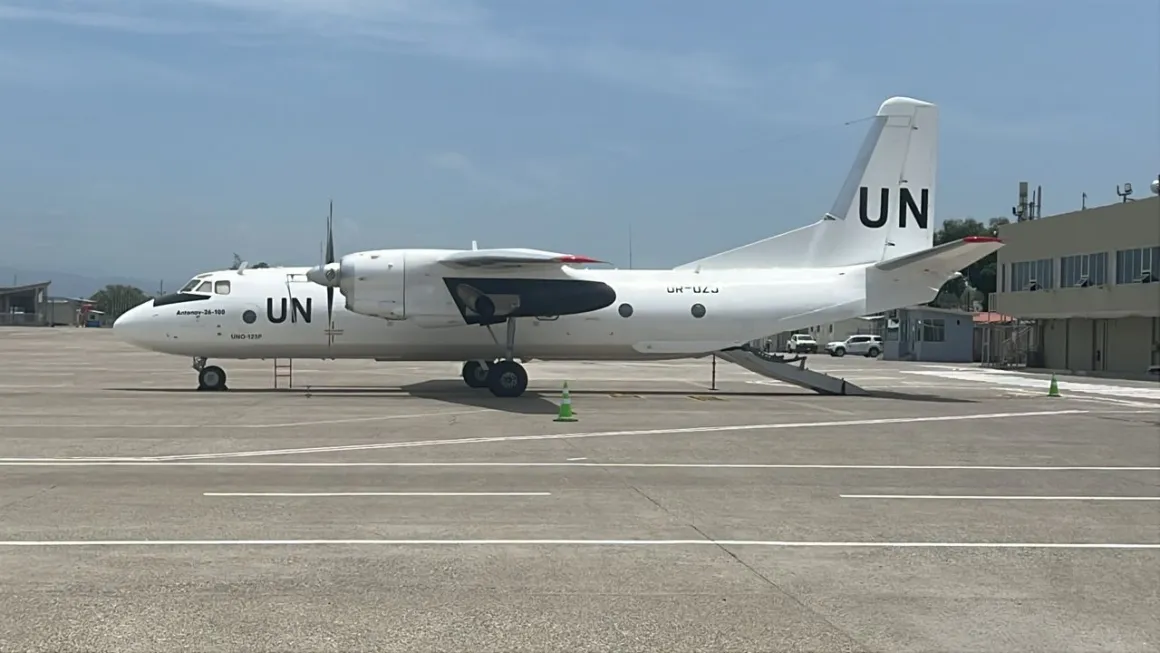
Aviation is an important part of the logistical and operational support provided by the United Nations Support Office in Haiti (UNSOH). Since deploying its first civilian helicopter on 12 January 2026, UNSOH has expanded its air capacity with a second helicopter and an airplane to support operations across Haiti.
Aviation support in practice
In Haiti, where security conditions can restrict movement, UNSOH's aircraft enable the transport of civilian personnel, equipment and supplies across the country. Regular air services also connect Port-au-Prince and Santo Domingo, in the Dominican Republic. These services do not include the transport of uniformed personnel and operate under United Nations aviation safety standards.
As of 30 August 2026, more than 2,055 passengers had been transported and over 440 flight hours logged since the first helicopter became operational. The aircraft had also supported two medical evacuations, on 7 August and 1 September 2026.
Extending support beyond Port-au-Prince
As Gang Suppression Force (GSF) deployments extend beyond Port-au-Prince, UNSOH is providing assistance to locations such as Gonaïves, about 150 km north of the capital, where the Force is deployed in support of the Haitian National Police. Flights to the city are operated as required to deliver logistical and technical support.
“The current UNSOH air mobility has significantly enhanced the mission's logistical, operational and medical evacuation capabilities. This has been particularly evident when travel by road has proved difficult. Our recent flights to Gonaïves are a key example of how we have been able to transport essential supplies and personnel despite limited ground transportation,” said Rajendra Koirala, Chief of Unit, Air Operations, UNSOH.
Supporting medical evacuations
UNSOH has established medical evacuation arrangements that include a 24/7 Medical Evacuation Coordination Centre and medical teams supporting patients during air transfers. Referral arrangements are also in place with specialized medical facilities in the Dominican Republic.
Dr Alioune Fall, Chief of Section, Medical, UNSOH, explained the importance of air transport for medical evacuations:
“For medical teams on the ground, this capacity means that when a patient needs specialized care, we can coordinate an air transfer at any hour and help them reach the appropriate facility without avoidable delay. It gives us a safe, reliable option when urgent care cannot be provided locally and every minute counts.”


