


On 30 September 2025, the United Nations Security Council adopted resolution 2793 (2025), requesting the Secretary-General to establish the United Nations Support Office in Haiti (UNSOH) to provide logistical, technical, administrative, and operational support to the Gang Suppression Force (GSF), as well as full mission-support services to the United Nations Integrated Office in Haiti (BINUH), the UN's political mission in Haiti.
This mandate also provides for support to the Haitian National Police (HNP) and the Armed Forces of Haiti (FAd’H) when they conduct joint operations with the GSF, as well as technical assistance and support to the Organization of American States (OAS), upon request.
UNSOH delivers the services and infrastructure required to fulfill this mandate, including accommodation, medical services, food and water, fuel, transport and aviation, information and communications technology (ICT), and other operational support.
UNSOH does not conduct or command counter-gang operations; rather it provides the operational assistance needed for the GSF to implement its mandate.
From mandate to first capability
Following the adoption of the resolution, the United Nations Department of Operational Support (DOS), in close collaboration with other United Nations entities and the Government of Haiti, led preparations to establish UNSOH.
On 1 April 2026, UNSOH reached initial operating capability, meaning the Office could begin receiving and supporting incoming contingents even as planned infrastructure, personnel, services, and equipment were still being put in place.

Since then, UNSOH has expanded its capacity to deliver support. Aviation and movement capabilities are connecting locations and moving personnel, equipment, and supplies, while infrastructure at Camp Vertières, the GSF's headquarters in Port-au-Prince, is accommodating incoming contingents. Medical arrangements provide emergency and evacuation capacity.
"UNSOH has moved from establishment to delivery. The capabilities now in place allow us to sustain a growing force, expand support beyond Port-au-Prince, and respond as operational requirements evolve.”
Getting essential support ready
As contingents deploy, UNSOH works with the GSF, contributing countries, and other partners to help ensure that services and infrastructure are in place. Bringing contingents and their equipment into place requires coordination across multiple stages, from international transportation and arrival in Haiti to the onward movement of equipment to its destination.
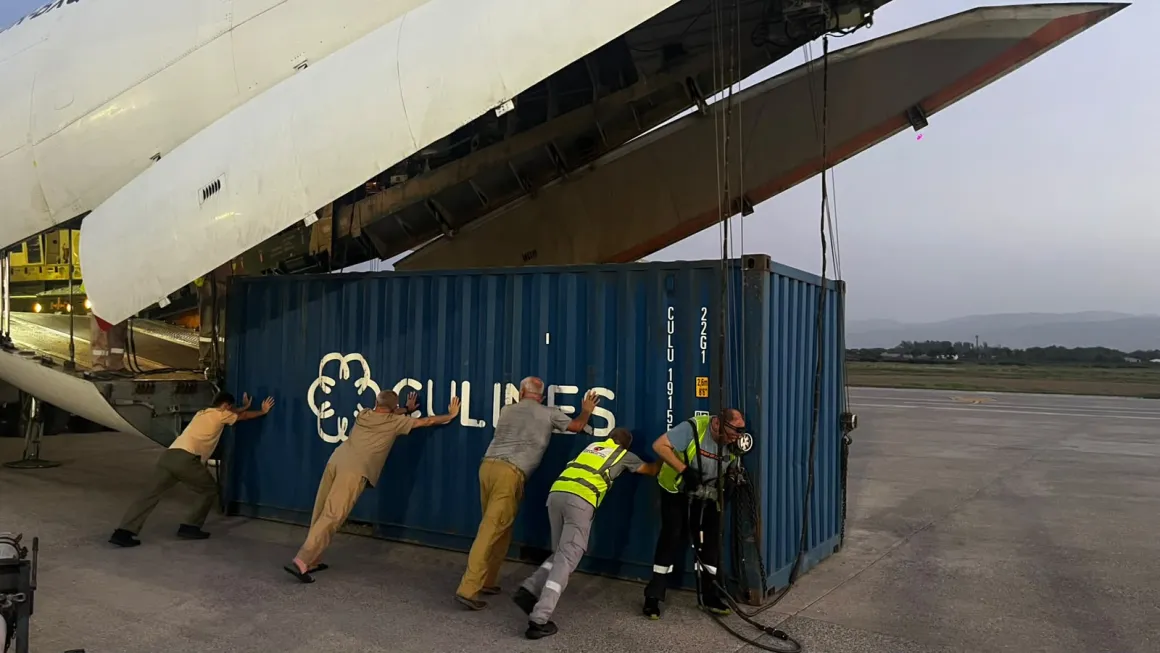
This includes accommodation, medical support, engineering, rations, fuel, and communications. The movement of Sri Lankan contingent-owned equipment illustrates the logistics involved. Between 2 July and 1 August 2026, 14 flights transported it from Colombo to Port-au-Prince. The equipment was transferred from the airport to the seaport before being moved by barge to Gonaïves, a city north of the capital where the contingent has been deployed via ferry.
Keeping support running
At Camp Vertières, UNSOH has built and upgraded facilities that support the GSF's presence. The Joint Operations Centre, completed by UNSOH on 25 May 2026, plays a crucial role in coordinating, monitoring, and managing operations. It is essential for information sharing, decision-making, and resource deployment during operations by facilitating real-time situational awareness and rapid response capabilities.
Medical support is another essential part of UNSOH's work. UNSOH has also established medical support capacity, including a Level 2 hospital providing emergency and stabilization care. This is complemented by a 24/7 Medical Evacuation Coordination Centre, medical teams supporting air evacuations, and arrangements with specialized medical facilities in the Dominican Republic for patients requiring a higher level of care.

As support requirements expand, UNSOH is also developing additional operational locations and support facilities both in and outside Port-au-Prince, as required by the GSF.
Supporting BINUH
UNSOH provides the full range of mission-support services to BINUH, helping maintain operational continuity in a challenging security environment. This includes administrative and logistical support, shared services, and coordination across support functions.
Through these arrangements, UNSOH supports the conditions that allow BINUH to continue carrying out its political, electoral, human rights, and rule of law activities.
Together, these efforts reflect UNSOH’s transition from establishment to sustained support delivery, with the infrastructure, services, and capacities needed to support the GSF and BINUH.


