

Following the official declaration of the 17th Ebola outbreak in Democratic Republic of the Congo on 15 May 2026, the United Nations peacekeeping mission in the country (MONUSCO) has rapidly deployed its air assets to assist the Congolese government and UN agencies in their response efforts.
MONUSCO is supporting Ebola response efforts in coordination with the World Health Organization (WHO) and other partners by providing critical logistical assistance to enable the rapid delivery of medical supplies and equipment to Bunia, where response efforts are being reinforced.
On 17 May, approximately five tons of emergency medical supplies arrived in Bunia from Nairobi through a WHO-chartered flight. The cargo included personal protective equipment, laboratory supplies, medicines and tents for patient care. Four vehicles and two motorcycles were also transported to Bunia from Goma and Entebbe to strengthen logistics on the ground.
On 18 May, MONUSCO supported the air transport of approximately 4,650 kilograms of medical supplies and equipment from the WHO regional warehouse in Nairobi. This was followed on 20 May by two additional cargo flights using MONUSCO aircraft, delivering about 7,957 kilograms of freight from Kinshasa and nearly 6,030 kilograms from Nairobi directly to Bunia.
In just four days, nearly 20 tons of supplies were airlifted to Bunia, highlighting the scale of the logistical response underway.
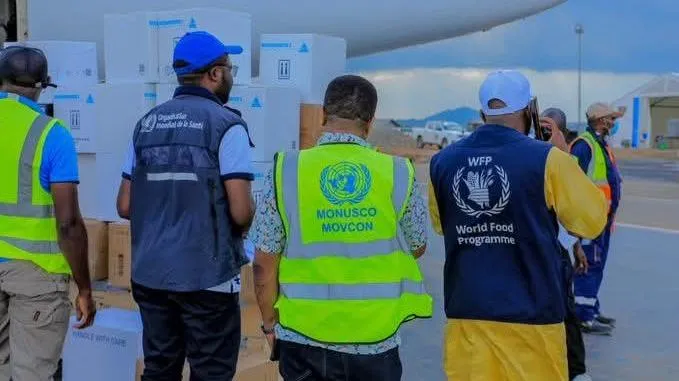
MONUSCO has also positioned a helicopter to support flights to affected areas in Ituri while two ambulances and two armored vehicles are also en route from Goma to Bunia to support medical evacuations and outreach operations in high-security-risk areas for WHO teams.
“The collaboration with MONUSCO has been pivotal in ensuring a swift response. Their ability to provide airlift support significantly enhances our logistics capabilities, allowing us to respond to the needs of the community effectively,” said Adama Thiam, Head of Regional Emergency Operations and Logistics at WHO Africa.
MONUSCO’s response extends beyond logistics. Military, police and civilian peacekeepers are also conducting community awareness campaigns to help prevent the spread of the disease.
In Tchabi, in Irumu territory, residents were sensitized on key preventive measures, including personal hygiene and the risks associated with bushmeat consumption. Similar outreach efforts were also conducted in Fataki, targeting internally displaced persons and local communities. These initiatives aim to enhance community preparedness and protect vulnerable populations, in line with MONUSCO’s protection of civilians' mandate.
According to official data as of 18 May 2026, 457 suspected cases have been recorded in Ituri, including 33 recent deaths, four of which were confirmed cases. A total of 131 deaths have been reported since the outbreak began.
The Mission remains closely engaged with WHO on logistics planning and operational coordination to help ensure the timely delivery of life-saving interventions to national authorities and health partners responding to the outbreak. MONUSCO reiterated its commitment, within its mandate and capabilities, to supporting efforts aimed at protecting affected populations and communities during this public health emergency.


